

Three tools, three completely different jobs
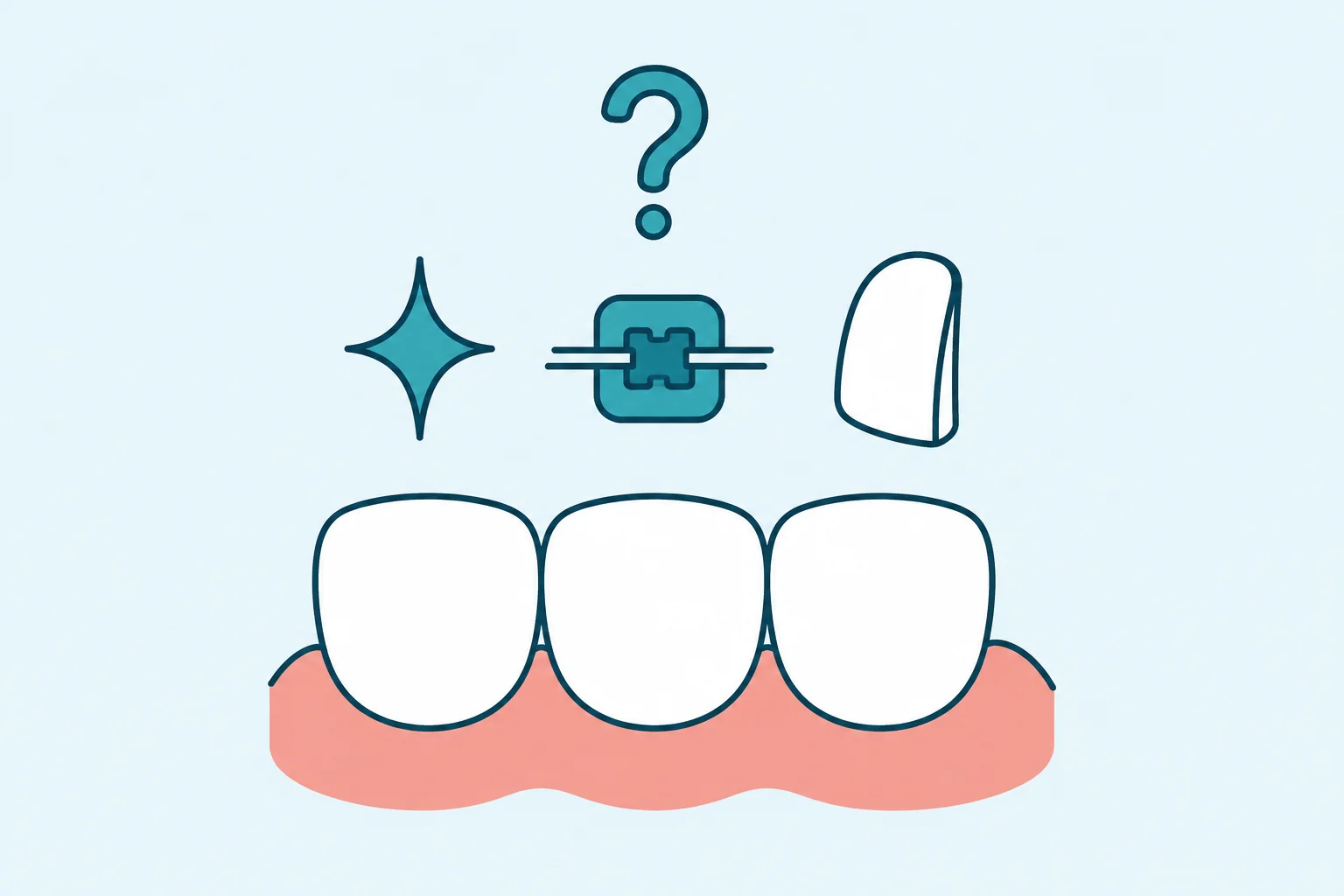
Most confusion about cosmetic dentistry comes from asking “which treatment is best?”, as if whitening, braces and veneers were three brands of the same product. They are not. Each one fixes exactly one kind of problem:
- Whitening changes colour. Nothing else: not shape, not position.
- Braces and aligners change position. They move teeth; they do not brighten or reshape them.
- Veneers and bonding change shape and surface. They can also mask colour, which is precisely why they get oversold for problems the other two solve better.
So the useful question is never “which is best”. It is: what is my actual complaint?
Start from the mirror, not the menu
“My teeth look yellow.” This is a colour problem, and the ladder starts cheap: sometimes a scaling alone brightens more than you expect, then professional whitening handles the colour inside the enamel. Before buying anything online, read what the strips and LED kits can and cannot do; if you are worried about safety, the enamel question has a good answer; and if your discolouration is grey, banded, or on a single dark tooth, whitening may be the wrong tool entirely.
“My teeth are crooked, or there is a gap.” This is a position problem, and moving teeth is the only honest fix: braces or aligners, compared plainly here. Age is not the barrier you think it is, a front-tooth gap has four options of its own, and whatever moves your teeth, retainers are what make it permanent.
“A tooth is chipped, worn, or an odd shape.” This is a shape problem: composite bonding for small corrections, veneers when the change must be bigger or last longer. The porcelain-versus-composite choice is mostly about lifespan and budget, and if you have seen scary videos about ruined teeth, read this first.
“Honestly, a bit of everything.” Then the order you do things in matters more than any single choice, which is the next section.
The sequence rule: health, position, colour, shape
When more than one treatment is on the table, the order is not negotiable, and each step protects the one after it:
- Health first. Decay and gum problems get treated before anything cosmetic; every treatment above assumes a sound foundation.
- Position second. Straightening first can shrink the rest of the plan: teeth that move into better positions often need no veneer at all, and a gap that closes orthodontically needs no ceramic.
- Colour third. Whiten when teeth are where they will stay, so the new shade is measured on the final smile.
- Shape last. Veneers and bonding are colour-matched to their neighbours, so they come after whitening, matched to the result, never before it.
The two expensive ways to do it backwards
Veneering over crooked teeth means grinding healthy teeth into a shape that fakes alignment; months of aligners would have moved them honestly and kept the enamel. Whitening after veneers leaves your new ceramic frozen at your old shade while the natural teeth around it brighten. Both mistakes are bought, not caught, because both look fine for a while, and both are the reason the sequence rule exists.
What a consultation actually decides
Not “which treatment can we sell you”, but which of the three problems you actually have, whether the least invasive tool gets you there, and what order protects your money if you need more than one. That conversation takes one check-up appointment, and it is cheaper than any wrong guess.
At Happy Tooth Dental Clinic in Puchong, we will tell you plainly which category your smile falls into, even when the honest answer is the cheapest one on this page. A good cosmetic plan starts with a mirror and one question: what exactly bothers you? Everything else follows from the answer.