

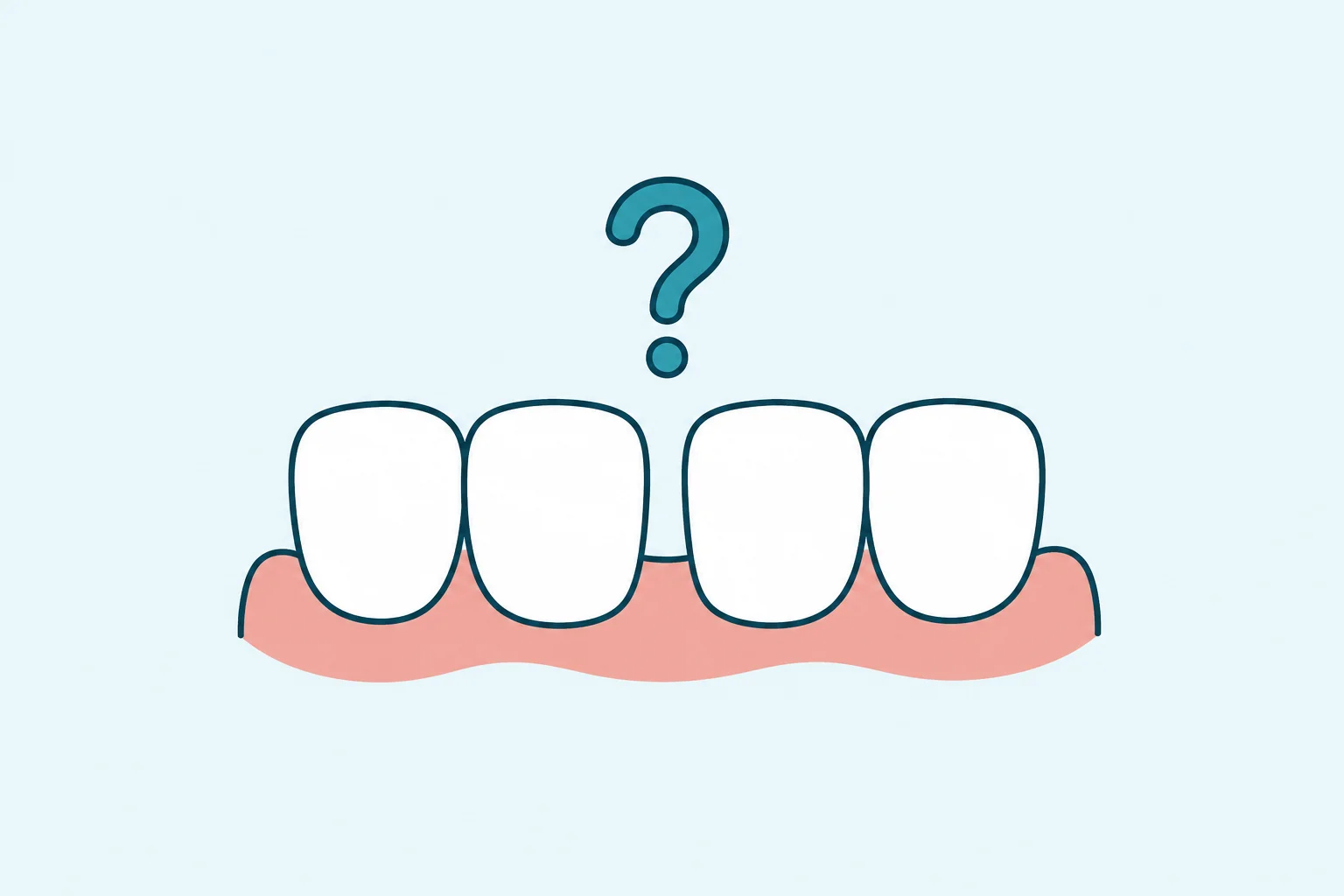
First, one question that changes everything
Has the gap always been there, or is it new?
A gap you have had since your teeth came in (dentists call it a diastema) is usually just anatomy: front teeth slightly small for the jaw, or a low band of lip tissue (the frenum) sitting between them. It is a cosmetic question, and you can weigh every option below at your own pace.
A gap that has appeared or widened in adulthood is different. Teeth do not wander for no reason; the common culprit is gum disease quietly loosening their foundations, and the gap is the visible symptom. Closing it cosmetically without treating the cause is redecorating a house while the ground under it moves. If your gap is new, start with a check-up and, if needed, gum treatment; the cosmetic conversation comes after.
Option 1: move the teeth (braces or aligners)
Orthodontics closes the gap by actually moving the teeth back together. It is the most thorough answer and the only one that touches no tooth structure at all: nothing is drilled, nothing is added, your teeth are simply in better positions. A small, isolated gap is often a short aligner case rather than a multi-year project.
The trade-offs are time (months, not weeks) and the retainer rule: closed gaps are famous for reopening, so the retainer afterwards is not optional fine print, it is the treatment. The full picture is in our braces and aligners comparison.
Orthodontics is the right call when the gap is one item on a longer list: crowding elsewhere, a bite that needs work, or several spaces rather than one.
Option 2: build the edges out (composite bonding)
The dentist sculpts tooth-coloured resin onto the sides of the two teeth, narrowing the gap in a single visit. No lab, usually little or no drilling, and the lowest price of any option here. For a small gap on otherwise healthy, well-aligned teeth, it is the sensible first option.
The honest limits: composite picks up stain over the years and needs re-polishing or redoing (we covered its lifespan in porcelain vs composite veneers), and a wide gap filled with bonding alone can leave the two front teeth looking noticeably broad. Bonding closes small gaps beautifully; it cannot redesign a smile’s proportions.
Option 3: re-face the teeth (veneers)
Veneers close the gap and redesign the shape, proportion and colour of the teeth in one move. They are the right tool when the gap is not the only complaint: teeth that are also discoloured in a way whitening cannot fix, chipped, worn, or uneven.
The trade-off is permanent: a thin layer of enamel is removed, and that decision does not reverse. For a gap on otherwise healthy, well-shaped teeth, veneers are usually more treatment than the problem deserves, and we will say exactly that if you ask us for them.
Option 4: keep it
A stable, original gap is not a disease. Plenty of famous smiles are built around one, and if yours does not bother you, no dentist should talk you out of keeping it. The only non-negotiable is knowing which kind of gap you have: stable anatomy you can happily live with, or quiet movement that needs attention.
How the choice usually goes
- Small gap, healthy straight teeth, want it done fast: bonding first.
- Gap plus crowding, bite issues or multiple spaces: braces or aligners.
- Gap plus colour or shape complaints on the same teeth: veneers earn their price.
- New or widening gap: gum health first, cosmetics second.
- Gap you have made peace with: keep it, with our blessing.
Look before you choose
The right option depends on the gap’s size, its cause, and the state of the teeth around it, which is exactly what an examination establishes. At Happy Tooth Dental Clinic in Puchong, we will tell you plainly which options genuinely fit your gap, what each costs in time, money and tooth structure, and which one we would choose in your position. The gap has bothered you for years; spending one appointment choosing the right fix is a good trade.