

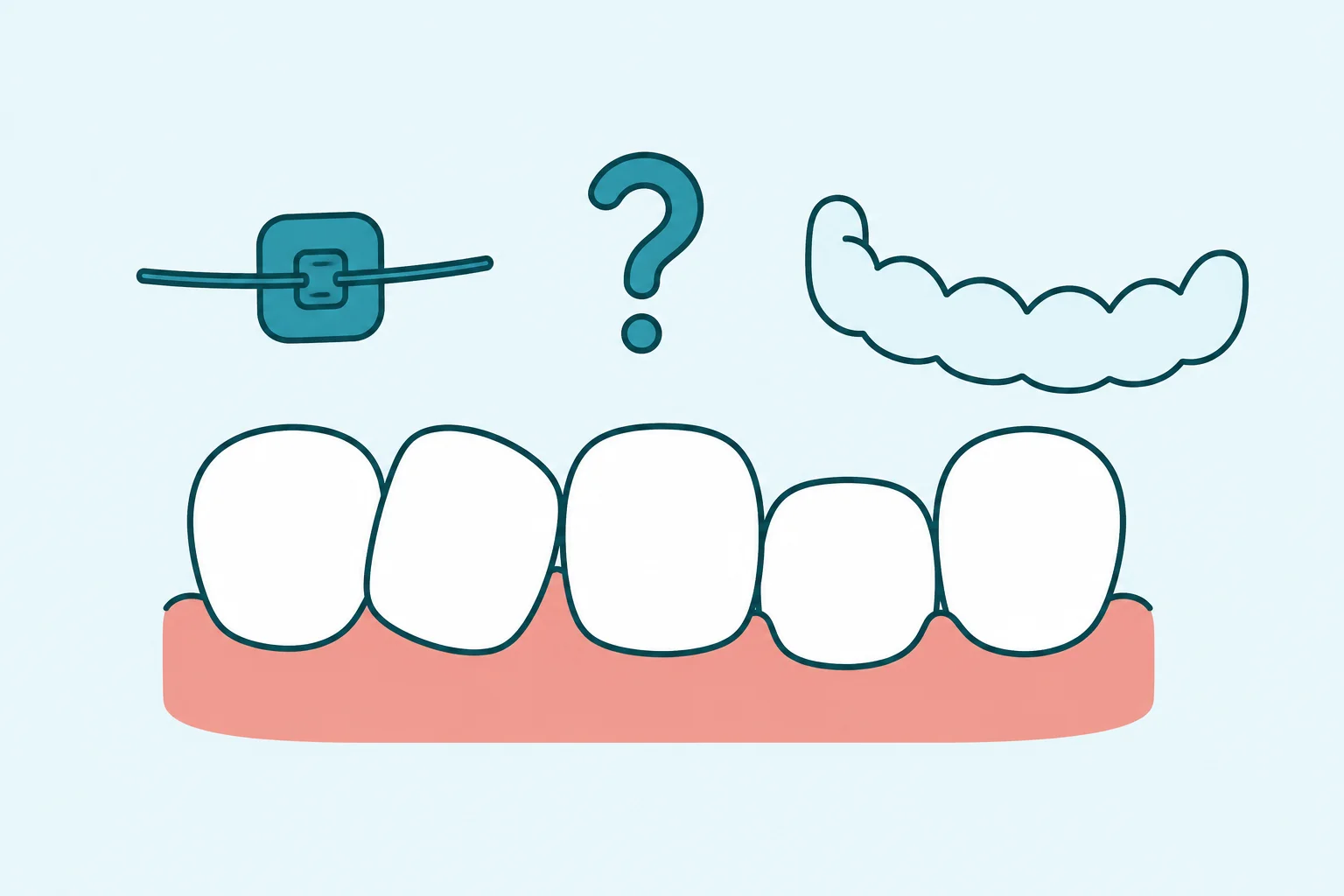
They move teeth in exactly the same way
Braces and clear aligners are two delivery systems for the same biology: gentle, continuous pressure on a tooth, held for months, while the bone around it remodels to lock in the new position. Braces deliver that pressure through brackets and a wire fixed to your teeth, adjusted at each visit. Clear aligners deliver it through a series of transparent removable trays, each one a small step ahead of where your teeth currently are, swapped every week or two.
Neither is a shortcut. Both take roughly 12 to 36 months depending on how far your teeth need to move, and both end the same way: with retainers holding the result. The real differences are not in the destination but in what the journey does to your daily life.
Daily life with braces
Braces work every hour of every day, whether you remember them or not. That is their greatest strength: no willpower required. The price is that they are fixed. Certain foods are off the menu (whole apples, hard nuts, ice, sticky sweets), brushing after every meal becomes a genuine task because you are cleaning around each bracket, and after each adjustment your teeth feel tight and tender for two or three days. They are also visible, although the adults in our chairs care about this far less than they expected to; a mouth full of effort reads differently at thirty-five than at fifteen.
Daily life with aligners
Aligners are nearly invisible, and they come out for meals, so nothing is off the menu. The catch is the flip side of the same feature: they only work while they are in, and they need 20 to 22 hours a day. Every kopi and teh tarik counts here, because anything other than plain water means taking the trays out and brushing before they go back in. If your day involves constant grazing, sweet drinks at the desk, or long client lunches, each of those moments is either a discipline test or lost treatment time. Aligner treatment does not fail in the clinic; it fails in the drawer.
What each one is genuinely better at
- Braces handle complex movements and bite corrections that aligners struggle with, they do not depend on your habits, and they usually cost less.
- Aligners excel at mild-to-moderate crowding and gaps, they are the discreet option for client-facing work, and because they come out for brushing, keeping teeth clean during treatment is much easier.
One honest warning while comparing: be careful with aligner packages sold online without an examination or X-rays. Moving teeth without knowing the state of the roots, gums and bone is not a bargain; it is orthodontics blindfolded.
Is one of them faster?
Not inherently. The timeline is set by how far your teeth have to move and how healthy the foundations are, not by which appliance pushes them. For some complex cases braces finish sooner because they control certain movements better; for a mild case the timelines are usually similar. Anyone promising that one option is simply “faster” before examining you is selling, not advising.
What about cost?
Aligners typically cost more than braces for the same case. Beyond that, complexity drives the fee more than the appliance does: mild crowding finishes faster and costs less than bite correction. What matters most is that the price you agree to is the whole plan, with adjustments, reviews and retainers included, rather than a starting figure that grows along the way. That is how we quote at our clinic, for either option.
Four questions to ask yourself before choosing
- Can you honestly keep trays in for 20+ hours a day, every day, for a year or more?
- Is your case mild or complex? Only an examination and X-ray can answer this, and it may decide for you.
- How much does visibility at work actually matter to you, versus how much you assume it should?
- Does the cost difference change what else you could do (for example, whitening after treatment)?
What both options demand
Healthy foundations first: decay and gum problems must be settled before any tooth is moved, so orthodontics starts with a check-up and often a scaling. And afterwards, retainers are not optional extras; they are what makes the result permanent. Teeth drift back without them, regardless of which appliance straightened them.
The honest answer: your case decides first
Some cases genuinely suit both options, and then lifestyle decides. Some belong firmly to braces, and we will say so even if the aligner fee is higher. At Happy Tooth Dental Clinic in Puchong, the orthodontic consultation gives you the full picture (whether treatment is needed at all, which options fit, the realistic timeline and the complete cost) before you commit to anything.