

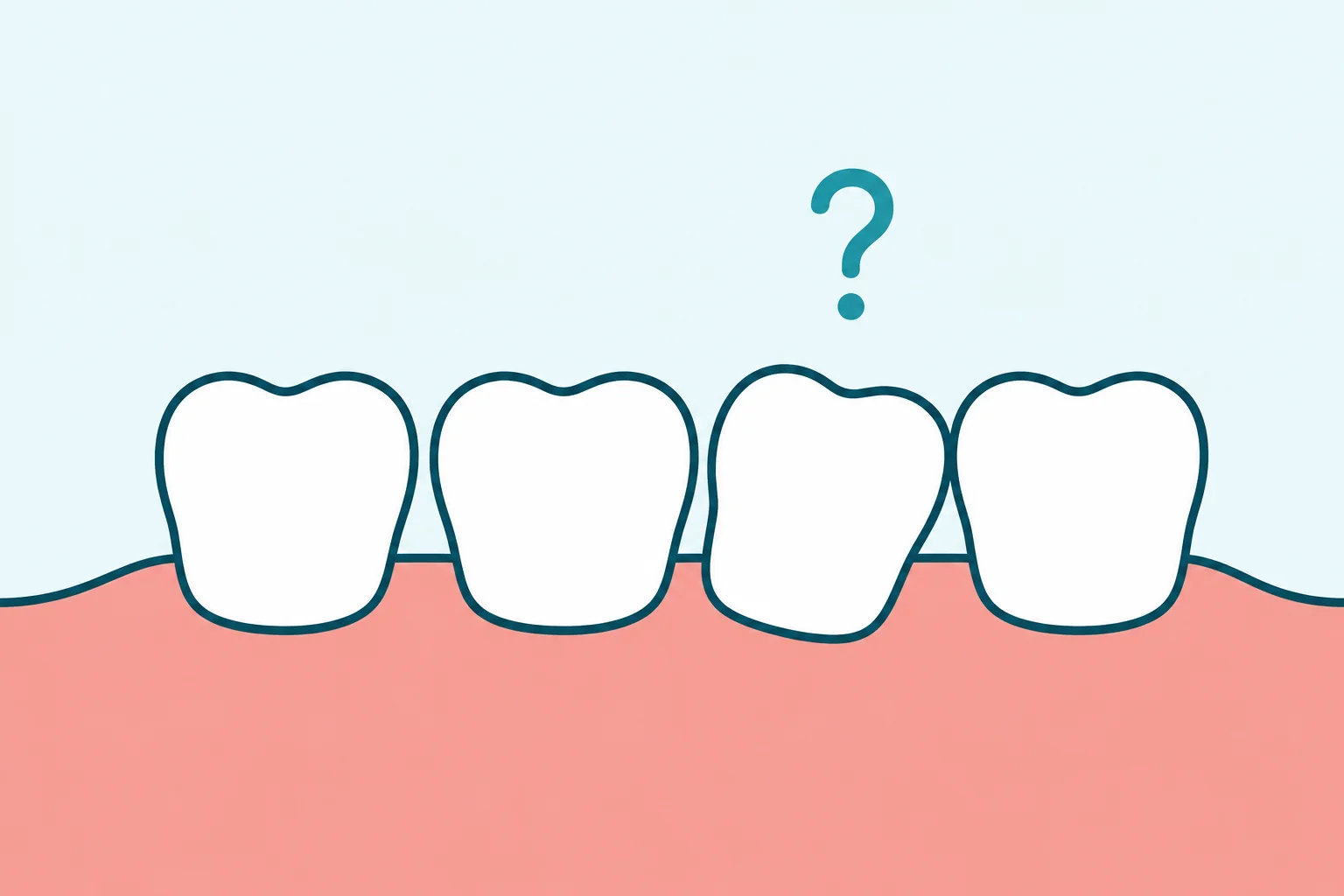
Why is it always the wisdom teeth?
Wisdom teeth are the third molars, the last teeth to arrive, usually between 17 and 25. The problem: by the time they show up, the seats are often taken. Human jaws have grown smaller through evolution, but the number of teeth has not, and as the last in line, wisdom teeth are the ones most likely to find no room. So they come in tilted, sideways, or stay trapped in the bone and gum altogether (what dentists call impacted).
The trouble with wisdom teeth is not that there is anything wrong with them as teeth. They simply arrived late to a full house.
Do wisdom teeth always need to be removed?
No, and this answer deserves to come first, because both extremes are wrong: “extract every wisdom tooth on sight” and “endure it forever” alike.
A wisdom tooth can stay when it has fully erupted, points the right way, bites properly against its opposite number, and your toothbrush can genuinely reach it. That is just a normal molar, and there is no reason to touch it.
Removal is usually recommended when at least one of these applies:
- Impacted or tilted: pressing into the second molar in front, or half-buried under the gum
- Repeated infections: gum pain around the tooth that keeps coming back
- Decay in it, or caused by it: sitting too deep to clean, where a cavity is only a matter of time
- A food trap: an uncleanable pocket forming between it and the neighbour
- Orthodontic plans: making room before alignment
The real question is not “do you have wisdom teeth?” but “are they causing trouble, and can you keep them clean?”
What is that swollen, painful gum near a wisdom tooth?
A partly-erupted wisdom tooth often wears a flap of gum over it. Food debris and bacteria slip into that pocket and cannot be cleaned out, and the flap responds by flaring up. This is pericoronitis, and most people who have grown wisdom teeth know it well: a swollen, aching gum, pain on biting, sometimes difficulty opening the mouth or swallowing. It also tends to flare up exactly when you are run-down, sleep-deprived or stressed.
Warm salt-water rinses and painkillers will get you through an episode, but honestly: as long as the flap and the pocket remain, the inflammation will return. Recurring pericoronitis is a clear sign that the tooth and your mouth are not going to get along.
My wisdom tooth doesn’t hurt, so can I just ignore it?
Painless is not the same as harmless: a tilted wisdom tooth does its damage quietly. It leans against the second molar at a contact point no brush or floss can reach, and a cavity develops there slowly, unseen. By the time anything hurts, it is often the healthy neighbour that is deeply decayed. The wisdom tooth itself is expendable; the second molar it drags down is one you need for life.
Which is why the keep-or-remove decision should not wait for pain. A single X-ray shows the tooth’s position, angle, and relationship to the neighbour and the nerve, and replaces “it’s probably fine” with a definite answer.
Is removing a wisdom tooth painful or scary?
Honestly, it depends on which of two situations you are in.
A fully erupted, normally positioned wisdom tooth is no different from any other extraction: local anaesthesia, pressure rather than pain, often quicker than you expect.
An impacted wisdom tooth needs surgical removal (opening the gum, sometimes sectioning the tooth). During the procedure you are properly numb and feel only pressure. Afterwards, expect two or three days of swelling and soreness: a real recovery, but one that ordinary painkillers manage, and most people are back at work within a day or two.
The full walkthrough of an extraction (the steps, aftercare, and how to avoid dry socket) is on our tooth extraction page.
When should you have yours assessed?
If the gum near a wisdom tooth has flared up more than once, if food constantly packs in around it, or if no dentist has ever actually looked at yours, it is worth a proper check. At Happy Tooth Dental Clinic in Puchong, one X-ray gives you a clear answer, and if your wisdom teeth are doing no harm, we will tell you exactly that: keep them, leave them alone. We only remove the ones that need removing; that is our principle for every tooth.