

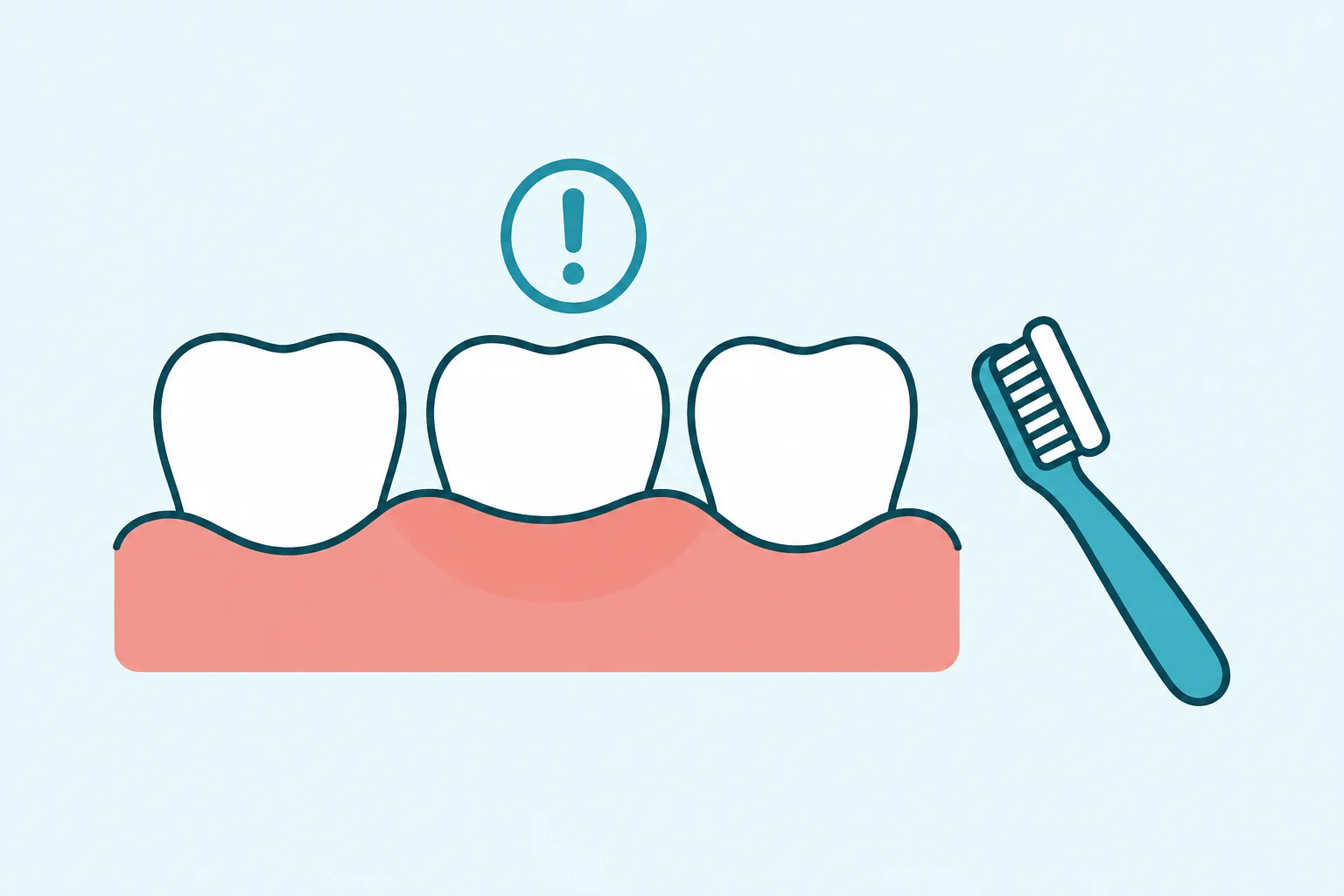
Is it normal for gums to bleed when brushing?
No, although it may be the most thoroughly “normalised” symptom in dentistry. Healthy gums do not bleed from ordinary brushing or flossing. Bleeding means the gum is already inflamed: inflamed tissue is engorged and fragile, and breaks at a light touch. A single episode might just be overenthusiastic brushing. But if there is blood every time you brush, that is the most reliable early sign of gingivitis, and it shows up at the stage when treatment is simplest.
Why do gums get inflamed in the first place?
In the vast majority of cases, the culprit is plaque and tartar accumulating along the gum line: bacteria settle in against the gum, and the gum responds with inflammation. That is also why bleeding tends to come from the same few spots. Those are the places your brush keeps missing.
Several things make it worse: pregnancy and hormonal changes make gums more reactive to plaque (pregnancy gingivitis is common); diabetes amplifies inflammation and slows healing; dry mouth from medications weakens saliva’s natural rinsing. One counter-intuitive point worth knowing: smokers’ gums often bleed less, not more. Nicotine constricts the blood vessels, so the gums look calm while the disease carries on underneath. Smokers’ gum disease is routinely discovered later and more advanced, because the usual warning sign was muted.
Should you keep brushing a spot that bleeds?
Yes, and this is where most people go wrong. At the sight of blood, the instinct is to avoid the spot, brush more softly, or quietly retire the floss. Unfortunately that starts a vicious cycle: less cleaning means more plaque, more inflammation, and more bleeding.
The right response is the opposite: keep brushing, gently but thoroughly, with a soft-bristled brush, and keep flossing. At the gingivitis stage, gums that are kept clean typically bleed noticeably less within a week or two, and you can watch that improvement from home. If two weeks of consistent cleaning changes nothing, the problem has moved beyond home care and it is time for an examination.
Where is the line between gingivitis and gum disease?
This boundary is worth knowing, because it separates the reversible from the irreversible.
Gingivitis means the inflammation is confined to the gum itself: redness, swelling, bleeding. The bone supporting the tooth is untouched. With a scaling and consistent home care, this stage is fully reversible, with no lasting damage.
Periodontitis (gum disease proper) means the inflammation has moved deeper. Bacteria colonise the pockets that form between gum and tooth and begin destroying the supporting bone. Lost bone does not grow back, and receded gums do not regrow — treatment at this stage stops the process and protects what remains. Loose teeth, widening gaps, and teeth that look “longer” are all signs of this stage.
The journey from gingivitis to periodontitis usually takes years, and bleeding is the warning that runs through all of them.
A quick self-check: how many of these apply?
- Regular bleeding when brushing or flossing
- Gums that look dark red or swollen (healthy gums are pale pink and firm)
- Breath that turns bad again shortly after brushing
- Gums pulling back, teeth looking longer
- A tooth that feels “different” or slightly loose when chewing
- A pimple or pus on the gum, now or in the past
Only the first three? Most likely still in the reversible stage, and the earlier you act, the simpler it stays. Any of the last three? Book an examination soon, because those are signs that bone is being lost.
What happens at the clinic?
The visit starts with measurement. Your dentist gently measures the depth of the pocket around each tooth with a fine probe, and those depths show which stage you are at. Caught early, a scaling plus a few home-care adjustments is usually enough. If deposits have moved below the gum line, the next step is gum treatment, which clears out the pockets so the gum can reattach.
At Happy Tooth Dental Clinic in Puchong, every routine check-up includes a gum assessment, and if a simple scaling is all you need, that is all we will recommend. The earlier bleeding gums are looked at, the simpler the treatment.