

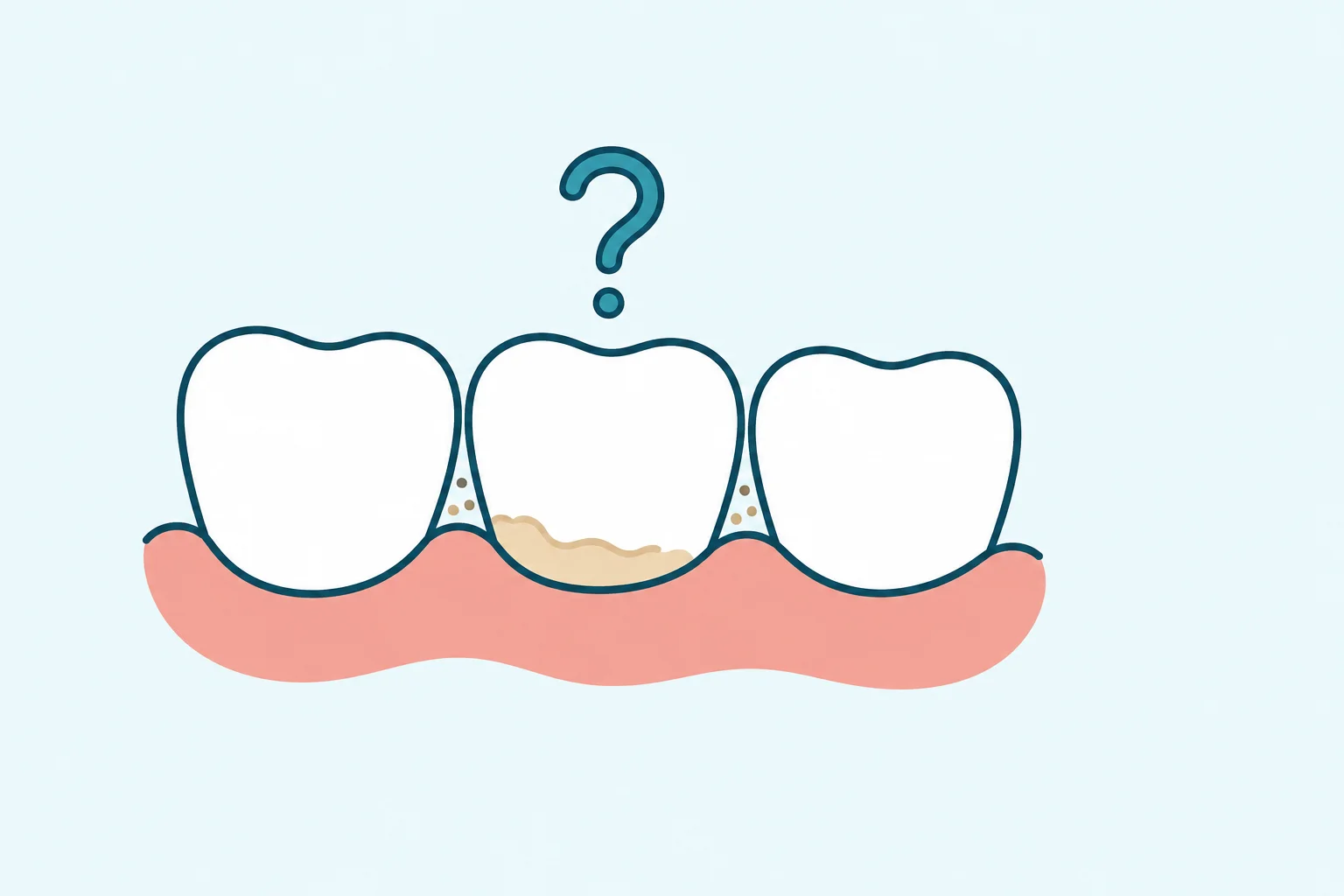
Where does tartar come from?
Within hours of brushing, plaque (a soft film of bacteria) starts re-forming on your teeth. Wherever your brush reaches, daily brushing keeps it under control. Wherever it doesn’t, minerals in your saliva start hardening that plaque within a day or two, gradually turning it into tartar (your dentist may call it calculus).
That is why tartar builds fastest at the spots nearest your saliva glands: behind the lower front teeth and on the cheek side of the upper back teeth. And because tartar has a rough surface, new plaque grips it more easily than it grips smooth enamel, so the buildup speeds up over time.
Why does tartar matter?
It is not just a cosmetic issue. Tartar is a fortress for bacteria, and it accumulates exactly where it does the most harm: along the gum line. Inflamed gums, bleeding when you brush, breath that never quite freshens: this is where they start. Given enough time, the bacteria work their way below the gums and quietly destroy the bone that holds your teeth. Gum disease is one of the most common reasons adults lose teeth, and the process is almost painless. By the time a tooth feels loose, the damage has been happening for years.
Why can’t I brush it off or scrape it off myself?
Tartar is the same kind of thing as limescale in a kettle: a mineral deposit, and a hard one. No toothbrush, floss, mouthwash or toothpaste can shift it.
What about those “dental scaler” tools sold online? Our honest advice: don’t, for three reasons. You cannot see what you are doing near your own gum line, and a sharp instrument slips easily, scratching enamel or stabbing the gum. Chipping off a piece of surface tartar leaves a rough ledge that new plaque colonises even faster. And most importantly, the tartar doing the real damage sits below the gum line, where you simply cannot reach. The surface may look cleaner; the destruction underneath carries on.
A professional ultrasonic clean clears tartar above and below the gum line safely in 30–45 minutes, and comes with a proper check-up of your whole mouth. This is genuinely not a thing to DIY.
Does scaling make gaps bigger or teeth loose?
This is probably the rumour that keeps the most people away from the dental chair, so it deserves a straight answer.
About the “bigger gaps”: tartar had been packing those spaces solid, and swollen, inflamed gums were filling part of them too. Once the tartar is removed and your gums shrink back to healthy, the spaces that were always there become noticeable again. The gap did not appear; the “cement” that was filling it disappeared. What feels like new space is actually your mouth returning to its healthy state.
About the “loose teeth”: a thick collar of tartar can act like a splint, binding together teeth that gum disease had already loosened. Scaling reveals looseness that already existed; it does not cause it. Leaving the tartar in place only lets more bone disappear, and that is what actually loosens teeth.
How often should tartar be cleaned off?
For most people, every 6 months. If you build tartar quickly, or your gums already have issues, your dentist may suggest a shorter interval, and will explain why. What the appointment is actually like, whether it hurts, and what to expect afterwards are all covered on our scaling and polishing page.
When should you see a dentist about it?
If you can see yellow-brown deposits along your gum line, your gums bleed regularly when brushing, or bad breath never quite goes away, book a scaling and let us take a proper look while we are at it. One thing to note: if your gums have been bleeding or receding for a long time, the tartar may have moved well below the gum line, and what you need is a deeper gum treatment rather than a standard scaling. At Happy Tooth Dental Clinic in Puchong, we examine first, then tell you honestly which one you actually need.