

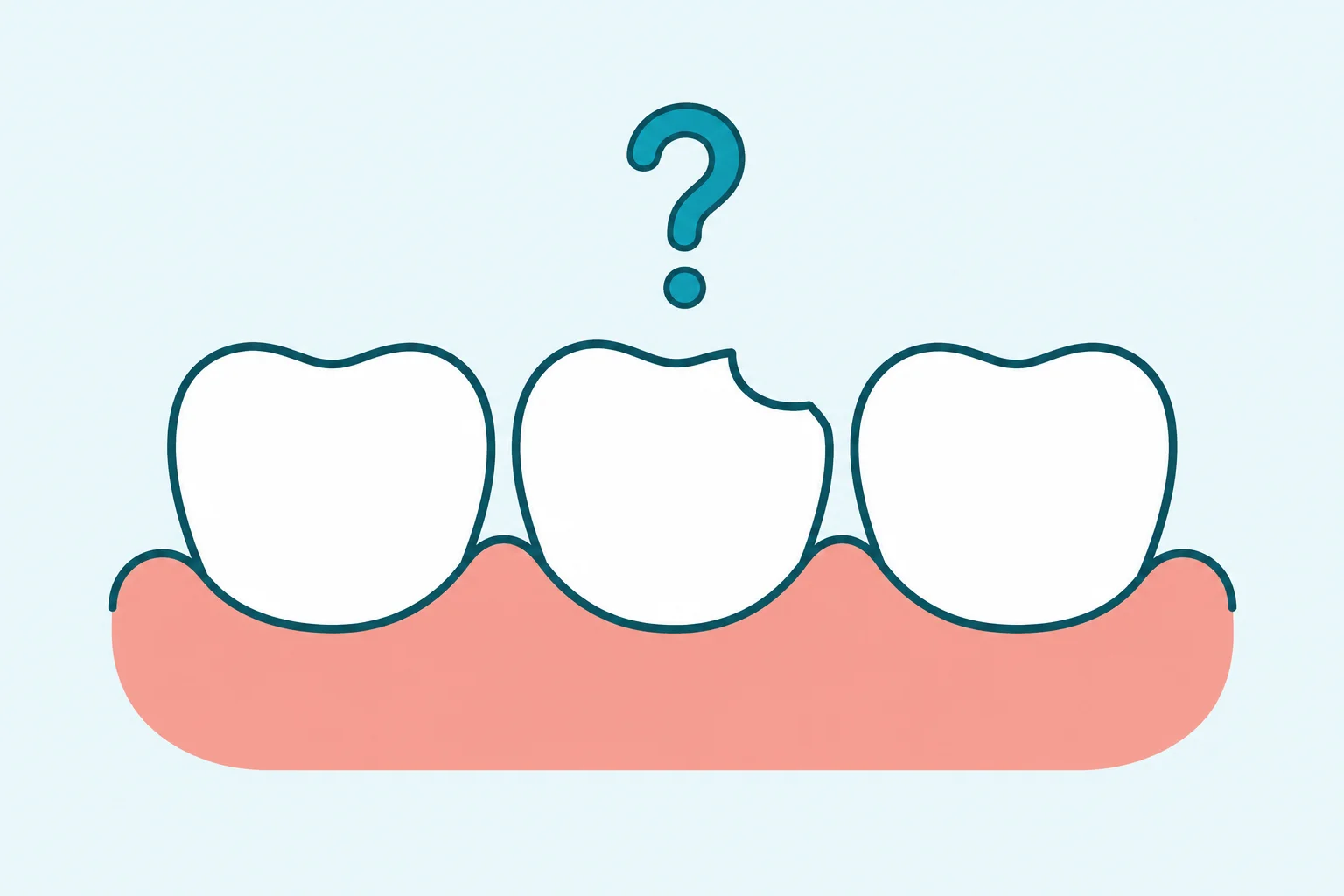
Is one missing tooth really a problem?
Especially a back tooth, where “nobody sees it anyway” is probably the most common decision made after an extraction. If the mouth were a static thing, that decision would be perfectly sound. The trouble is that it is not: teeth spend every day bearing load, shifting, and propping each other up. Every tooth is held in its place by its neighbours and by the tooth it bites against. Remove one, and the mechanics around the space start to rearrange.
Nothing happens in the short term, which is exactly what makes it deceptive. The changes run on a scale of months and years, and they are almost silent.
What actually happens after a tooth goes missing?
- The neighbours tilt. The teeth on either side of the gap lose their support and lean gradually into the space. A tilted tooth forms an uncleanable trap against its neighbour, and decay and gum problems follow.
- The opposite tooth over-erupts. The tooth that used to bite against the missing one, now meeting nothing, slowly grows out towards the gap. As it lengthens, its root becomes exposed, making sensitivity and looseness more likely.
- Chewing migrates to the other side. You start favouring the good side without noticing, doubling the wear on those teeth and sometimes straining the jaw muscles and joint on the neglected side.
- The bone shrinks. Chewing forces travelling down a tooth’s root are what keep the jawbone around it stimulated. With the root gone, that section of bone slowly resorbs, becoming lower and narrower. This is one reason why, after years of waiting, even wanting to fill the gap can become complicated.
In short, a gap never stays just a gap. Left alone, it slowly pulls the healthy teeth beside and opposite it out of position.
Do you have to decide right away?
No, and you should not. The gum takes a week or two to close after an extraction, and the bone underneath keeps remodelling for months. The day of the extraction is actually the worst time to decide, which is why nobody at our clinic will sell you a replacement on the way out of an extraction appointment.
But “no rush” is not “indefinitely later”. Once the neighbours have visibly tilted or the opposing tooth has grown down, a once-simple replacement becomes complicated: a bridge may no longer seat evenly, the space for an implant may have closed, and sometimes orthodontics is needed first just to stand the teeth back up. The honest timescale: take a few months to compare your options calmly, but do not let the decision drift into years.
What are the three ways to fill a gap?
- A bridge (fixed). Crowns on the teeth either side of the gap carry a replacement tooth between them, cemented as one piece: nothing to remove, stable, no surgery, done within a couple of weeks. The trade-off is that the neighbouring teeth must be trimmed to act as anchors, so a bridge is at its best when those neighbours are strong. The full process is on our crowns and bridges page.
- A denture (removable). Economical, spares the neighbouring teeth, and can replace several teeth at once, which makes it the pragmatic choice for larger gaps. The trade-off is that it comes out daily for cleaning, and it will never feel quite as much like your own teeth as a fixed option.
- An implant (artificial root). A titanium root placed in the jawbone, carrying its own crown. It leaves the neighbours untouched, feels closest to a natural tooth, and is the only option that keeps stimulating the bone. The trade-offs: it involves surgery, runs on a timescale of months, costs the most, and depends on adequate bone and general health.
There is no universally “best” option, only the one that best fits your gap’s position, your neighbouring teeth, and your budget.
Which one is right for me?
The key variables: how healthy the teeth either side of the gap are (strong neighbours make a bridge sensible; struggling ones should not be asked to carry it), how many teeth are missing and where, your budget and your feelings about fixed versus removable, and the state of the bone. None of this can be judged from an article; it takes an examination and an X-ray.
At Happy Tooth Dental Clinic in Puchong, we lay the suitable options out plainly (what each gives you, what each costs you, and why), and then the decision is yours, unhurried. Replacing a missing tooth should never be a sales pitch; it is an honest conversation about the mechanics of your mouth.